
Picture the most capable person you know. Now imagine them completely falling apart before the most important moment of their life.
That's Arjuna. Greatest archer of his age. Years of training. Unbeatable in battle. And right before it matters most, he puts down his bow and sits on the floor of his chariot.
"My limbs fail. My mouth is parched. My body trembles. My hair stands on end." (Bhagavad Gita 1:29)
That's not poetry. That's a clinical description of a panic attack. And it happened five thousand years ago, to someone who had every reason to be confident.
Sound familiar?
Why Krishna Doesn't Say "Just Calm Down"
Here's the first surprising thing about the Gita. When Arjuna has his breakdown, Krishna doesn't offer comfort. He doesn't say "breathe" or "you've got this" or "think positive thoughts."
He gives him a diagnosis.
And the diagnosis is this: Arjuna is suffering because he has confused himself with his circumstances. He's made his sense of self completely dependent on how this battle turns out. And because he can't control how it turns out, he's paralyzed.
This is still the most accurate description of anxiety I've ever read. You're not anxious about the thing itself. You're anxious because somewhere, deep down, you've tied your worth to whether that thing goes well.
The Verse Everyone Quotes But Nobody Explains Properly
Karmanye vadhikaraste ma phaleshu kadachana.
"You have the right to perform your duties. You do not have the right to the results." (Bhagavad Gita 2:47)
If someone has told you this verse means "work hard and don't expect anything," they've missed the point. Completely.
This verse isn't about becoming emotionally detached or not caring about outcomes. It's about where you place your sense of self. Think about it: the only time you're truly free from anxiety is when you're fully absorbed in doing something well, without tracking whether it's working. Athletes call it flow. The Gita calls it the natural state of a person doing what they're meant to do.
The anxiety comes when you start calculating. When you step outside the action and start running simulations about whether you'll succeed, what people will think, what happens if it goes wrong. That calculation is not wisdom. That calculation is what destroys you.
Your Mind Is Not Your Friend Right Now
"For one who has conquered the mind, the mind is the best of friends. For one who has failed to do so, his very mind will be the greatest enemy." (Bhagavad Gita 6:6)
Your overthinking mind genuinely believes it's helping you. It thinks all that scenario-planning is preparation. All that replay of past conversations is learning. All that imagining worst cases is prudence.
It isn't. It's just burning you out.
The Gita isn't asking you to stop thinking. It's asking you to become someone who can observe their thoughts without being run by them. There's a version of you that can sit with uncertainty without spinning. Not numb to it. Just not destroyed by it.
The Two Things That Actually Help
When Arjuna pushes back and says "but the mind is so restless, so strong, so hard to control — it's like trying to stop the wind," Krishna doesn't argue. He says: yes. It is that hard. Here's what works anyway.
Abhyasa. Practice. Consistent return. Every time the mind goes somewhere unhelpful, you notice, and you come back. Not once. Every day. The first week it feels impossible. The first month it starts to feel like effort. After a year, it starts to feel like coming home.
Vairagya. Letting go. Not trying to suppress thoughts but learning to not follow every single one. You feel the anxiety. You don't fuse with it. It's there. You're also still there. And slowly, the gap between you and the anxiety becomes something you can actually stand in.
The Thing About Arjuna's Breakdown
The entire Bhagavad Gita — all eighteen chapters, arguably the most important spiritual text ever written — exists because Arjuna broke down. His anxiety, his paralysis, his willingness to stop and say "I don't know what to do," created the opening for everything Krishna taught.
Your overthinking isn't evidence that you're broken. It's evidence that something in you is asking a question that deserves a real answer.
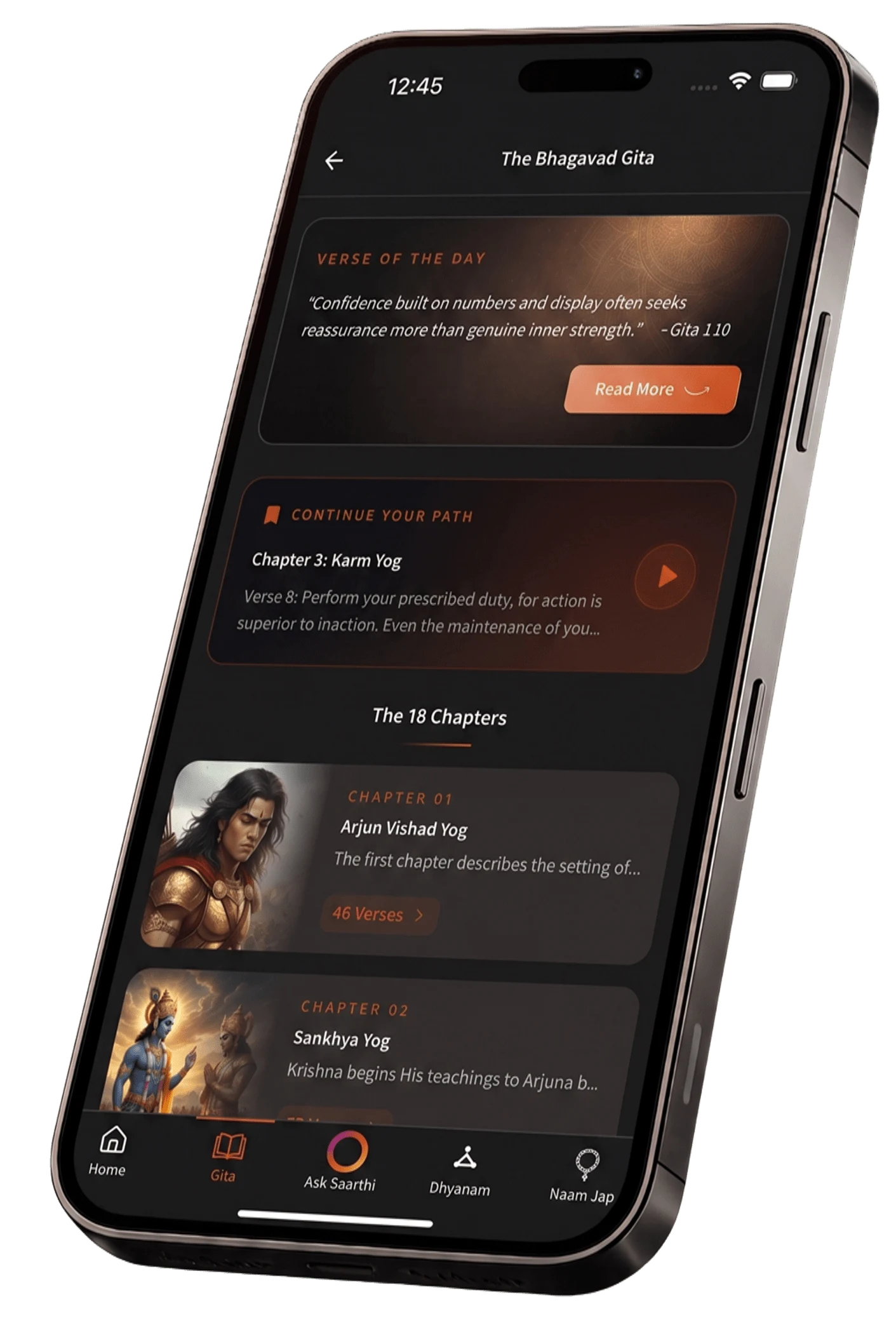
The Arutra app has Saarthi AI — a Gita-trained companion that you can talk to at 2am when the thoughts won't stop. Ask it about these verses. Tell it what you're dealing with. Get answers that are rooted in scripture and shaped for your actual life. The wisdom has been waiting five thousand years. It can wait five more seconds while you download the app.
Experience it on Arutra
Download the Arutra App
Guided Bhagavad Gita sessions, Bhagavad Gita verses, Saarthi AI, and more. Free on Android and iOS.