
You've achieved things. Some of them you worked really hard for. And there's been more than one moment, sitting with something you'd wanted for years, when you've thought: this isn't it. There has to be more than this.
That feeling is not ingratitude. It's not depression. The Bhagavad Gita calls it the beginning of real intelligence.
The Question Arjuna Was Actually Asking
On the surface, Arjuna's crisis is about whether to fight in a battle. But the deeper question he's asking — the one Krishna spends eighteen chapters answering — is: what am I supposed to do with my life? What actually matters? Who am I underneath all these roles?
He's a son. A brother. A warrior. A student. A king's nephew. But strip away all the roles, and what's left? What does he actually want? What is he actually here for?
That's your question too. Even if your battlefield looks like an open laptop at 11pm.
Dharma Is Not "Duty"
The word dharma is usually translated as duty, but that translation loses something essential. Duty sounds like obligation. Something imposed from outside. Something to grit your teeth through.
Dharma is closer to this: the way a thing most naturally expresses its deepest nature. Fire's dharma is to burn. Water's dharma is to flow. Your dharma is the particular way you're meant to be in the world — the combination of your nature, your skills, your deepest values, and the specific context of your life.
When you're living your dharma, there's a kind of ease even in the hardest work. When you're ignoring it, there's a friction that never quite goes away, even when everything looks fine from the outside.
The Verse That Explains Why You Feel Wrong in Someone Else's Life
"Better to perform one's own dharma imperfectly than to perform another's dharma perfectly." (Bhagavad Gita 3:35)
This verse should be tattooed on the inside of every school counselor's office.
The Gita is saying: even a messy, uncertain, figuring-it-out version of your authentic life is better than a perfect performance of someone else's definition of success. The engineer who wanted to be a musician. The doctor who wanted to write. The person who made every sensible choice and still feels like they're living someone else's story.
Your svadharma — your own particular dharma — isn't a job title. It's not a personality type. It's a quality of being that, when expressed, makes you feel most fully yourself. Finding it requires honest self-observation, not a five-year plan.
The Four Purposes the Gita Recognizes
The Gita doesn't say life has one purpose. It recognizes four, in order of depth.
Artha: security, resources, the ability to sustain yourself and those you care for. Real and legitimate.
Kama: pleasure, beauty, connection, the things that make life enjoyable. Also real and legitimate.
Dharma: righteous living, acting according to your nature and values. This is where meaning enters.
Moksha: liberation. The recognition of what you actually are beneath all the roles, identities, and stories. This is the Gita's highest answer to the question of purpose.
Most people are fully focused on artha and kama. The Gita isn't dismissing those. It's saying they won't give you what you're actually looking for. That thing you're looking for lives in dharma and moksha.
When Purpose Feels Hidden
Not everyone has a dramatic sense of calling. Most people don't wake up knowing what they're meant to do. The Gita's teaching on purpose is less about discovery and more about orientation.
Before you can know what you're here to do, you need to know what you are. And the Gita's consistent answer to that question is: you are not the body, not the roles, not the résumé, not the reputation. You are the witnessing awareness behind all of it. When you start to know that even provisionally, the question of purpose gets much simpler. It becomes: what can I do, from where I am, with what I have, that expresses my deepest nature and serves something larger than my ego?
That's it. That's the whole answer. The daily practice of asking and answering that question is living with purpose.
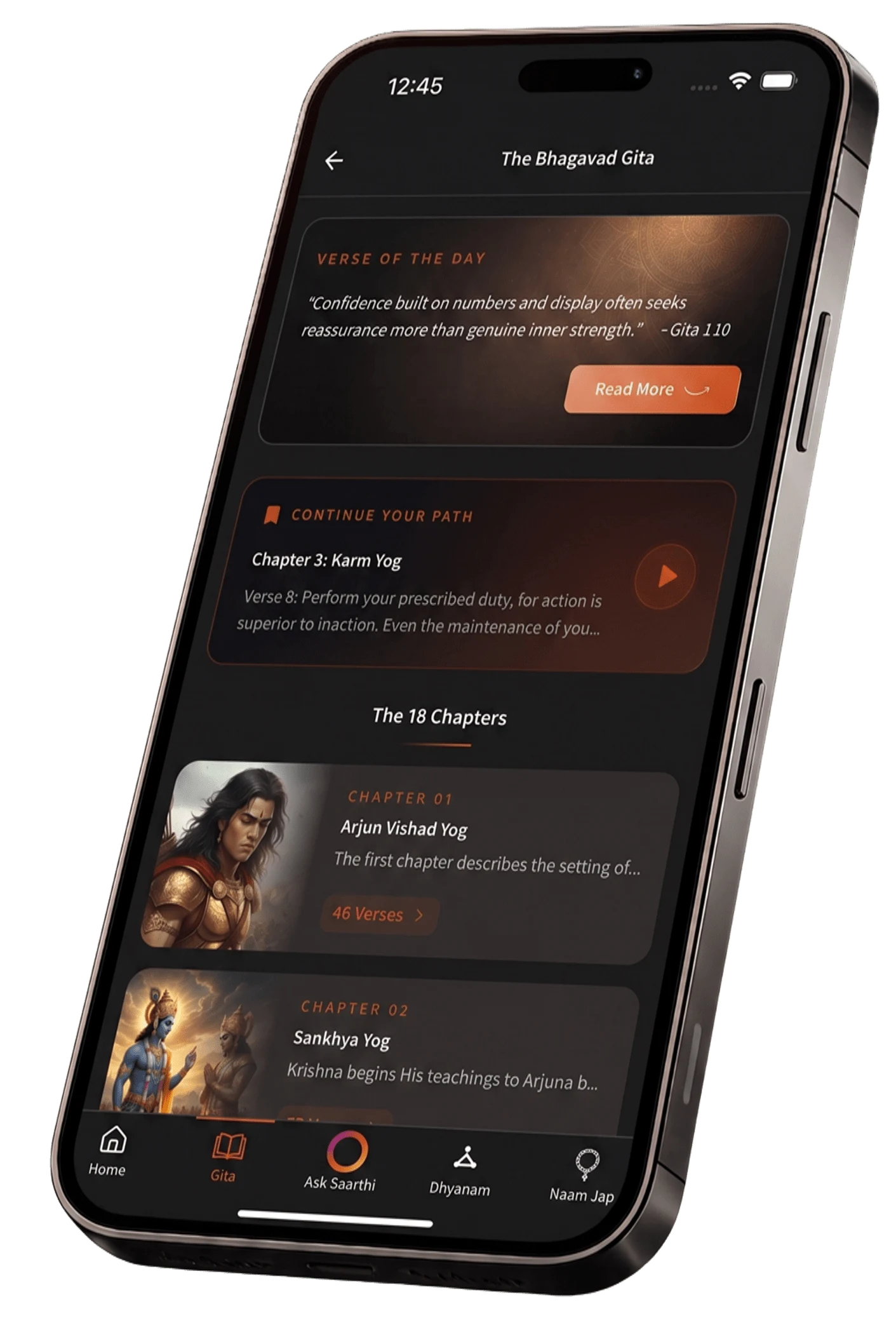
Explore the Gita's teachings on dharma and moksha in the Arutra app. Saarthi AI can help you think through where you are in relation to these four purposes — and what, specifically, might be holding you back from the life that's actually yours.
Experience it on Arutra
Download the Arutra App
Guided Bhagavad Gita sessions, Bhagavad Gita verses, Saarthi AI, and more. Free on Android and iOS.