
Before a single verse of the Bhagavad Gita's teaching is spoken, Arjuna is already mourning. He sees his teachers on the opposite side. His cousins. His grandfather. He knows the battle is coming and he knows people he loves will die, regardless of who wins.
He has already lost before it begins.
This is the context in which everything Krishna says is spoken. Not from a comfortable distance. Not from someone who hasn't suffered. From right in the middle of it.
The First Thing Krishna Says
"The contacts of the senses with objects, O Arjuna, which give rise to cold and heat, pleasure and pain, have a beginning and an end. They are impermanent." (Bhagavad Gita 2:14)
Before anything else. Before talk of karma, dharma, the soul, or duty. Krishna says: this has a beginning and an end. It is not permanent.
This is not toxic positivity. Krishna isn't saying the pain doesn't matter or that everything happens for a reason. He's giving Arjuna the one fact that makes survival possible: what is happening right now is not the final word. The heaviness you are feeling is real. And it is not eternal.
The failure you're sitting with today has a before and an after. You are in the middle, which always feels like there is no after. There is.
What Actually Got Destroyed
Here's the thing about failure that nobody says clearly: what hurts most is rarely the practical consequence. It's the identity wound. The quiet voice that says if this didn't work, then I'm not enough.
You didn't get the promotion. Somewhere in you, a voice says: so you were never really capable.
The relationship ended. Somewhere in you, a voice says: so you were never really loveable.
The business failed. Somewhere in you, a voice says: so you were never really smart enough to do this.
The Bhagavad Gita's entire teaching on the atman — the real self — is an answer to this voice.
The Soul Cannot Be Defeated
"The soul is never born and never dies at any time. It is unborn, eternal, ever-existing, and primeval. It is not slain when the body is slain." (Bhagavad Gita 2:20)
Read that in the context of failure. The soul — the witnessing, continuing, essentially whole part of you — cannot fail. It can have an experience of failure. It can be redirected, delayed, confused, humbled. But it cannot be destroyed.
You are not your outcomes. You have never been your outcomes. The version of you that exists under the roles and results and reputation is untouched by any of this. The Gita is not asking you to pretend the failure didn't happen. It's asking you to know, deeply, that the failure did not happen to the most essential part of who you are.
Equanimity Is Not Numbness
The Gita describes the wise person as "sama-dukha-sukha" — equally minded in happiness and suffering. People sometimes misread this as not feeling anything. That's not it.
The goal isn't to not feel the loss. It's to not be annihilated by it. To be someone who can grieve fully and still be standing. To feel the weight of what happened and remain connected to something in yourself that the weight cannot touch.
This is a practice, not a personality type. It's built by repeatedly returning to who you are underneath the story about what happened.
Rising, Not Just Recovering
The Gita does not ask you to recover. Recovery means going back to what you were. The Gita is asking you to rise — to become the person this experience has made room for. Every major character in the Mahabharata passes through enormous loss. Their greatness is not that they avoided it. It's that they refused to let it be the final definition of who they were.
Your failure is not your story. It's a chapter. And how you carry yourself through it is writing the rest.
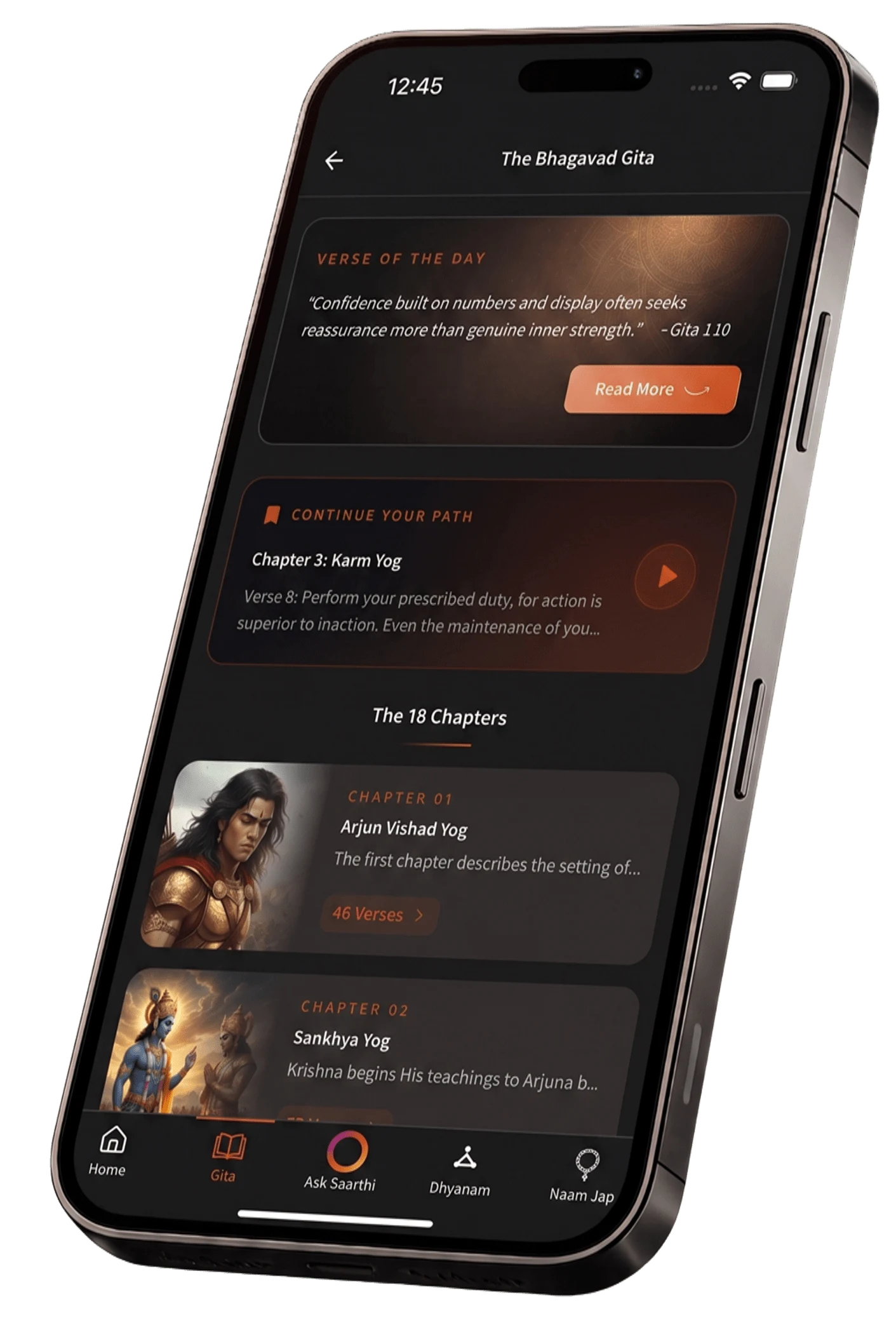
The Arutra app sends you one Gita verse every morning. During difficult periods especially, that daily contact with this wisdom becomes something to lean against. Start there. Let Saarthi AI walk you through Chapter 2, verse by verse, at whatever pace you need.
Experience it on Arutra
Download the Arutra App
Guided Bhagavad Gita sessions, Bhagavad Gita verses, Saarthi AI, and more. Free on Android and iOS.